
Amish Refrigerator Pickles
Every summer when the garden cucumbers start piling up on the counter, I reach for this recipe. It reminds me of my grandmother’s kitchen, where jars of sweet and tangy pickles always sat in the ice box, ready to add a crunchy bite to any meal.
She never bothered with a hot water bath or complicated canning. Her method was simple, and I still follow it today.
This heirloom recipe for Amish Refrigerator Pickles is as straightforward as it gets: crisp cucumber slices, strips of green pepper, and onion rings all swimming in a bright vinegar brine.
In just one day they transform into that classic sweet, and sour pickle we all crave.

I love how the sugar balances the cider vinegar so no single flavor overpowers the others. You’ll notice a gentle celery seed note, too, a signature of many old fashioned pickle recipes.
While my grandmother stored hers in a real ice box, I just tuck the jars into the refrigerator next to the milk and eggs.
The same combination of fresh vegetables and simple pantry ingredients turns out crunchy, never mushy, pickles that taste like a little bit of family history.
Jump to:
- Amish Refrigerator Pickles
- Refrigerator Pickles
- How to Make Refrigerator Pickles
- Ingredients (Makes 6 Pint Jars)
- Step by Step Instructions
- Variations for Refrigerator Pickles
- FAQs
- How long do Amish refrigerator pickles last in the fridge?
- What is the difference between refrigerator pickles and canned pickles?
- How do you make Amish refrigerator pickles crunchy?
- Can I use regular cucumbers for Amish refrigerator pickles?
- Amish Refrigerator Pickles
- Ingredients
- Instructions
- Last Step:
- Did you make this recipe?
Refrigerator Pickles
Refrigerator pickles are exactly what the name suggests: pickles you keep in the fridge instead of on a pantry shelf. Because you never process the jars in boiling water, the vegetables stay noticeably crisper and more garden fresh.
That crunch is one of the main reasons I make these all summer long. There is no special canning equipment required, just clean jars with tight fitting lids.
You do need to sterilize the jars, but that is as simple as running them through the dishwasher or submerging them in boiling water for a few minutes while you slice the cucumbers.
These pickles will keep well in the refrigerator for several weeks, although in my house they rarely last that long.
The flavor continues to develop after the first day, so the jar you open on day three often tastes even better than the one you sneak a piece from right at the 24‑hour mark.
Unlike shelf stable canned pickles that can become soft over time, a refrigerator pickle holds its texture beautifully. My grandmother always told me that a cold pickle is a happy pickle, and after all these years I have to agree.
How to Make Refrigerator Pickles
The hands on work for this recipe takes around 20 minutes, and most of that is slicing and filling jars. There is no cooking step; you simply stir together the pickling liquid and pour it over the raw vegetables. Here is what you need and how to put it all together.
Ingredients (Makes 6 Pint Jars)
- 3 medium cucumbers, sliced about ¼ inch thick
- 1 green pepper, sliced into short strips
- 1 onion, sliced into rings
- 2 cups cider vinegar
- 2 cups granulated sugar
- 2 teaspoons celery seed
- 4 tablespoons kosher salt
Step by Step Instructions
- Clean and sanitize 6 pint size mason jars along with their lids and bands. I use the dishwasher on the sanitize cycle, but a pot of boiling water works just as well. While the jars dry, slice the cucumbers, pepper, and onion. Divide the vegetables evenly among the jars, packing them gently but not crushing the slices.
- In a large bowl or pitcher, combine the cider vinegar, sugar, celery seed, and kosher salt. Stir until the sugar and salt dissolve. Pour the liquid into each jar until it reaches about halfway. Then top off each jar with cold water, leaving a little headspace at the top.
- Screw the lids on tightly and give each jar a good shake to distribute the brine and seasonings. Place the jars in the refrigerator and let them rest for at least 24 hours. After that, they are ready to eat. Give the jar another gentle shake before serving to make sure every slice gets coated.
That is all there is to it. The hardest part is waiting that first day while the cucumbers soak up all the tangy sweetness. I often make a double batch so I have one jar to open right away and several more to enjoy later in the week.
Variations for Refrigerator Pickles
You will notice that this base recipe does not include dill. My family prefers the straightforward sweet, and sour taste, but if you love a dill pickle, it is easy to adapt.
Add up to 6 fresh dill sprigs or 1 teaspoon of dill seeds to each jar before pouring in the brine. The flavor comes through beautifully without overwhelming the cucumber.
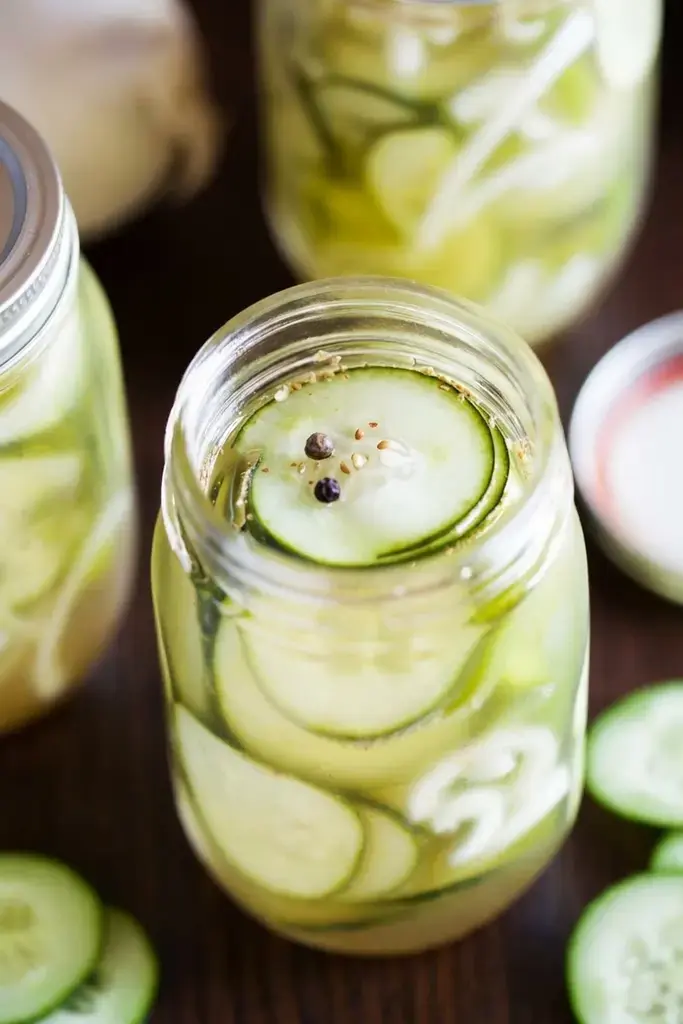
Another simple twist is to tuck a couple of whole garlic cloves into each jar. Keep the papery skins on; they will infuse a soft garlic note that mellows as the pickles sit. My grandfather always asked for that little hint of garlic, and now my kids do the same.
If you prefer pickle spears over slices, choose very firm cucumbers. Wash them, cut each cucumber in half crosswise, then place the flat side down and slice lengthwise into spears.
Hold a spear up to the jar to check the height before packing them all in. Baby cucumbers are perfect for this style and look gorgeous lined up in a straight jar.
No matter which variation you choose, the method stays the same, and the result is always a crisp, refreshing treat straight from the refrigerator.
FAQs
How long do Amish refrigerator pickles last in the fridge?
What is the difference between refrigerator pickles and canned pickles?
How do you make Amish refrigerator pickles crunchy?
Can I use regular cucumbers for Amish refrigerator pickles?

Amish Refrigerator Pickles
Amish Refrigerator Pickles Every summer when the garden cucumbers start piling up on the counter, I reach for this recipe. It reminds me of my grandmother’s kitchen, where jars of sweet and tangy pickles always sat in the ice box, ready to add a crunchy bite to any meal.
- Total Time: 20 min
- Yield: 6 jars 1x
Ingredients
3 medium cucumbers, sliced about ¼-inch thick
1 green pepper, sliced into short strips
1 onion, sliced into rings
2 cups cider vinegar
2 cups granulated sugar
2 teaspoons celery seed
4 tablespoons kosher salt
Instructions
1-Clean and sanitize 6 pint size mason: Clean and sanitize 6 pint size mason jars with lids. Divide the sliced cucumbers, pepper, and onion amongst the jars.
2-Create the pickling liquid by mixing together: Create the pickling liquid by mixing together the vinegar, sugar, celery seed, and salt. Fill the jars halfway with the liquid. Fill each jar the rest of the way with cold water.
3-Fit the lid on tightly and shake: Fit the lid on tightly and shake to mix. Store in the refrigerator for at least 24 hours.
Last Step:
Please leave a rating and comment letting us know how you liked this recipe! This helps our business to thrive and continue providing free, high-quality recipes for you.- Prep Time: 20 min
- Cook Time: 0 min
- Method: no_cook